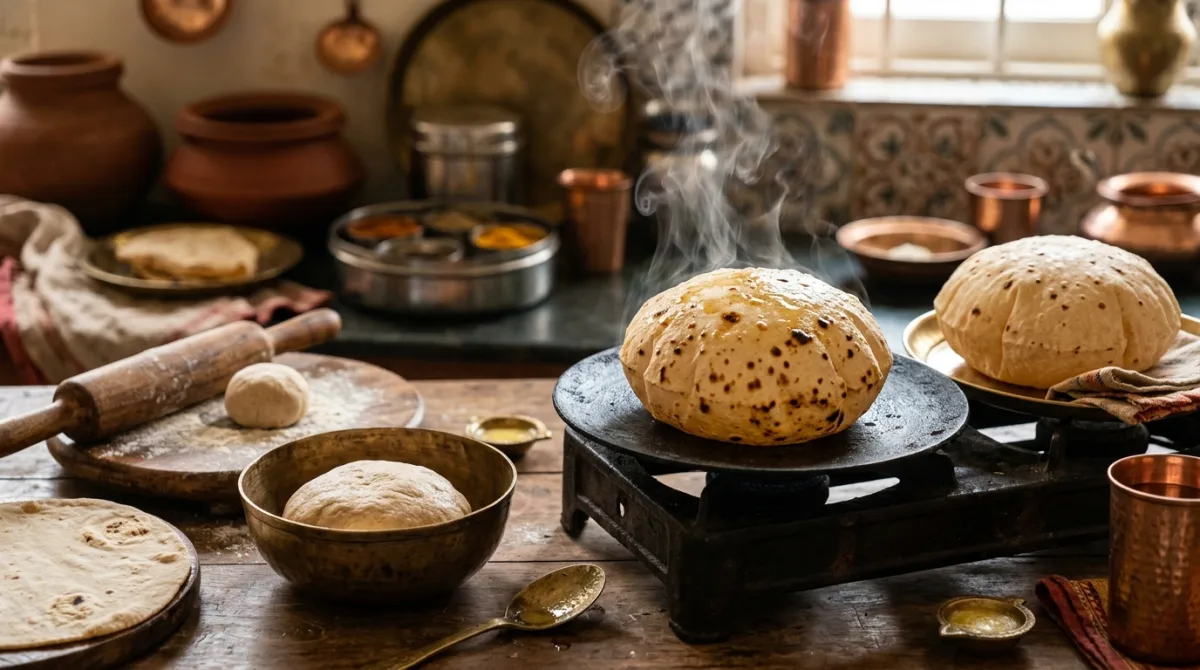
To watch an authentic Indian phulka puff effortlessly into a magnificent golden balloon—its dual delicate membranes parting under internal steam pressure, releasing a cloud of sweet wheat aroma—is among the purest visual joys of culinary heritage. Yet, for millions of home cooks and professionals alike, achieving that consistent tenderness remains notoriously unpredictable. Some days the rotis are heavenly; other days they emerge tough, brittle, or stiff within an hour.
The Culinary Truth
Perfection in a roti is not magical good fortune; it is a masterclass in biochemical protein alignment, starch gelatinization, and heat transfer thermodynamics. Master four foundational variables—water temperature, hydration ratio, autolyse resting, and the 3-flip tawa protocol—and you will never produce a dry roti again.
1. The Molecular Ballet: Gliadin, Glutenin & Disulfide Bonds
When whole wheat flour meets water, two primary storage proteins awaken and engage in a delicate biochemical choreography:
- Gliadin (The Extensibility Factor): Folded globular proteins that impart fluidity, stretchiness, and flow. Gliadin allows you to roll the dough outward without tearing.
- Glutenin (The Tensile Backbone): Long fibrous protein chains that form strong cross-linked disulfide bonds, providing elasticity and structural bounce-back.
If you under-develop this network, the roti will tear when rolled and cannot contain expanding steam. If you over-knead cold dough aggressively, the glutenin strands lock tightly, making the dough spring back during rolling and yielding a rubbery, chewy bread. The goal is a balanced, relaxed viscoelastic sheet.
2. The 40°C Rule: Why Lukewarm Water is Non-Negotiable
The most common home kitchen mistake is kneading flour with cold tap water. Starch granules in whole grain flour are densely packed crystalline structures with tight intermolecular hydrogen bonds. Cold water bounces off their outer perimeter, leaving internal starch cores dry.
By utilizing lukewarm water between 38°C and 42°C (100°F–108°F):
- Water molecules gain kinetic energy, penetrating coarse bran flakes and aleurone layers 3x faster.
- Endogenous alpha and beta-amylase enzymes activate, breaking down complex starches into natural maltose sugars that tenderize the crumb.
- Gluten proteins hydrate smoothly without requiring aggressive muscular kneading or excess fat/oil.
3. The Secret Weapon: The 20-Minute Autolyse Rest
Pioneered by the legendary French bread scientist Professor Raymond Calvel, Autolyse is the process of mixing flour and water until just combined, then letting the dough rest undisturbed before finished kneading.
When you apply this principle to Indian whole wheat atta:
What Happens During the 20-Minute Rest?
- Bran Softening: The coarse, sharp edges of fibrous wheat bran absorb ambient moisture and become soft, preventing them from slicing through delicate gluten strands during rolling.
- Enzymatic Relaxation: Natural protease enzymes gently snip excessive tension points in the gluten web, completely eliminating dough "snap-back."
- Effortless Finishing: After a 20-minute autolyse, you only need 60 to 90 seconds of gentle folding to achieve a dough with the smooth, satiny texture of fine silk.
4. Tawa Thermodynamics: The Master 3-Flip Protocol
Cooking a roti is fundamentally a race against dehydration. The core culinary objective is to cook the top and bottom exterior crusts just enough to form an airtight vapor barrier, then vaporize internal water into 100°C steam to expand the cavity before the flatbread dries out.
| Step / Stage Duration & Heat Biochemical Action Visual Indicator | |||
| Tawa Preparation | Preheat 3–4 mins | Heavy cast iron or carbon steel tawa heated to ~200°C (390°F). | A water droplet sizzles and vaporizes in 2 seconds. |
| Flip 1: Flash Skin | 15 – 20 seconds | Gelatinizes top starch layer into an airtight flexible seal. | Tiny pin-prick blisters appear; underside remains pale. |
| Flip 2: The Foundation | 35 – 45 seconds | Cooks structural base; starch gelatinizes fully; builds internal steam pressure. | Even golden-brown freckles develop across underside. |
| Flip 3: Steam Expansion | 10 – 15 seconds | Internal liquid water flashes into superheated steam (expanding 1600x in volume). | Magnificent, full balloon puff on flame or cloth press! |
5. Troubleshooting Matrix: Kitchen Diagnostics & Instant Fixes
Problem: Rotis turn leathery or stiff
Root Cause: Under-hydration or tawa temperature too low (cooking took >2 minutes, drying out the dough).
Fix: Increase water by 10%, ensure water is lukewarm, and increase tawa flame so total cooking takes under 80 seconds.
Problem: Roti fails to puff up
Root Cause: Uneven rolling thickness or a cracked edge allowing high-pressure steam to leak out.
Fix: Roll gently from center to perimeter without pressing down hard on edges; maintain uniform 1.5mm thickness.
Problem: Roti turns hard after packing
Root Cause: Steam condensation inside airtight plastic container or cold aluminium foil.
Fix: Apply a light veil of pure Desi Ghee while warm; wrap in 100% breathable cotton muslin before placing in an insulated casserole.
6. Frequently Asked Questions (Master Culinary Secrets)
Q1: Should I add oil or milk while kneading the dough?
When using premium cold-stone ground Sharbati flour, oil or milk is completely unnecessary. The natural intact wheat germ contains natural plant oils, and high water hydration (68%–72%) with autolyse resting naturally provides far superior, long-lasting tenderness without added dietary fats.
Q2: Can I store kneaded whole wheat dough in the refrigerator?
Yes, up to 24 hours. Place the dough ball in an airtight container with a light coat of ghee on top to prevent surface skinning. Because real unbleached flour contains active enzymes, refrigerated dough may darken slightly due to polyphenol oxidase—this is a natural badge of chemical-free flour. Bring the dough back to room temperature before rolling.
“A tender phulka is the ultimate expression of kitchen love. When you respect the science of water temperature, dough autolyse, and unadulterated whole grain purity, everyday cooking transforms into culinary mastery.”